|
|
Recently in Dog Communication Category
A. We humans
use hugs to communicate our affection. Dogs also use gestures - like nuzzling, nudging and rubbing up against either - to show affection. Using human gestures on our
canine companions, however, can make them uncomfortable.
Here are some suggestions on how to let your dog know how much you love him WITHOUT making him flinch!
NOTE: Parents, please share this with your children.
- Respect your
dog's space. Since dogs don't hug like we do, they often feel cornered or trapped when hugged. Instead of hugging, try petting him instead.

- To a dog, petting is similar to nuzzling. It's relaxing and calming to him. The most enjoyable type of petting we can give a dog is to stroke him under his chin and on his chest. Dogs that are hypersensitive to touch because of age or illness may find even the softest touch startling, so keep your movements slow and even.
- Don't pick
up your small dog. While most of us cannot physically pick up a Bull Mastiff, we don't
hesitate to swoop down and lift tiny dogs like Bichons or Chihuahuas. We forget
that no matter how small, a dog is still a dog. Being held is simply not natural to a dog and puts him
in a position where he may feel trapped, or injured if he should fall.
- Grabbing your dog's collar to deal with issues like jumping
up or bolting out the door can be viewed as very threatening. You may have noticed that the more you pull back on
your dog's leash or collar, the more he pulls forward. This is
a natural, built-in reaction that can cause damage
to the dog's neck and back.
- Help your dog get used to being handled
physically for nail clipping, grooming, washing, and veterinary checkups by gently touching his body, head, and feet every day. Make these sessions pleasant by giving him treats, which are both a reward for his good behavior and a distraction while he is being groomed or examined.
By building a foundation of trust with your dog, he will understand that your touch is not only enjoyable but will keep him safe from harm. 
A. Dog
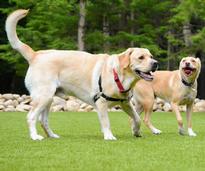
parks can be a great way to socialize your dog, but not all dogs do well at them. Here are some things to think about before you bring your dog to a dog park: 
-
Know your dog. If your dog is naturally cautious, shy, or doesn't get along well with other dogs, a dog park is not the place to help him overcome his issues. Meeting too many dogs at once is the equivalent of putting someone with claustrophobia in a closet. Too much too soon. Try
introducing your dog to a friend's dog that you know interacts well with
other dogs. A one-on-one play date might be just the ticket for a fun playtime for your best friend.
-
Vaccinate your dog. For his safety as well as the other dogs at the park, keep him up-to-date on his inoculations and worming
medications.
-
Check the park out first.
Visit the park without your dog and watch
the dogs there interact. If the dogs seem too rough for
your dog, come back at another time or try a different dog park.
-
Make the initial visit a short one. 15
minutes or so is enough. Slowly increase the length of your stays as your dog becomes
more comfortable there.
-
Pick the best time to go. Weekday
evenings, weekends and holidays are the busiest times at dog parks. Try to avoid going when your dog could be easily overwhelmed.
- Supervise your dog.
It's easy to get distracted talking to other owners. Keep an eye on your dog at
all times to make sure his interactions with other dogs are safe. Watch his body language and be ready to remove him if he seems stressed or if another dog won't leave him alone.
-
Let your dog off leash as soon as you enter unleashed areas. Mixing
leashed and unleashed dogs can create a hostile situation. A leashed dog can't make the choice
his natural instinct tells him of "fight or flight"--if he cannot take
flight, he may have to fight.
-
Leave children at home. You can't
watch your kids and your dog at the same time. Rowdy dogs can scare - and possibly hurt - children.
-
Don't bring a puppy. Puppies
less than four months old aren't fully immunized yet and are at higher
risk for contracting diseases. They are also very vulnerable to being
traumatized by another dog's aggressive behavior.
-
Don't bring toys or food. Most
parks already have plenty of balls and toys that other people have
brought. Rewarding your dog with treats or giving him toys in front of
other dogs can create jealousy and aggression.
-
Know when to leave. Remove your dog from the park if he is being threatened or
bullied and seems fearful. If your own dog begins to display aggressive behavior by
becoming overexcited or threatening toward other dogs, take him out. A tired dog that is panting
heavily also should go home.
-
Watch for potential dogfights. Don't
allow your dog's over excitement turn into a fight.
Its not a failing of your dog if he doesn't like going to the dog park. A hike with you or a game of fetch in the backyard can be just as fun and rewarding for him. Don't force your dog to be a party animal if it is just not his temperament.
A. I'll bet your dog - and mine does this, too - looks right at me when I'm talking to him, tilts his head, and seems to completely comprehend whatever I tell him.
Dogs are experts at reading our body language because they are pros at using their OWN bodies as a way of communicating with us. When you think about it, its really the only way (besides barking) that they do "talk" to us, and to other dogs, too.
Does your dog nudge your hand sometimes? Its a pretty good guess that he is asking you to pet him. When he drops a ball
next to you and then looks from the ball to you, you probably figure that he wants
to play. These are just two examples of how dogs communicate with their bodies.
Your dog watches you all the time. Does he get excited when you put on an old
pair of running shoes? He's watched you put them on before taking him for a walk many times, so he knows what happens next. He probably gets excited and wags his tail. Now YOU know what he is saying "Let's Go!"
You can learn your own dog's language by watching him. After awhile, you'll start to know what he is thinking, and what he will most likely do next. So next time when he looks at your sofa, then walks over to the sofa, then sniffs the sofa, you might guess (correctly) that he is about to jump up on it. If you don't want him on the sofa, you can stop him BEFORE he gets on it.
After awhile, you'll be (almost) as good at reading your dog's body language as he is at reading yours! For fun, try taking a dog body language quiz by clicking HERE. 
|
|
Recent Comments