|
|
Recently in Pet Ownership Category
A: Probably. Your dog may have become used to having the whole family around. Suddenly, everyone is gone during the day! Dogs are creatures of habit, and so any change in routine can affect them. Here are some suggestions for keeping your dog content - and out of trouble - when he is left alone for long periods of time.  While dogs naturally sleep a lot during the day, when they
wake up, they want something to do. Provide toys and activities that can keep
your dog entertained, even when you're not at home. Some examples are:
- Scatter
food - Dogs are natural foragers who enjoy sniffing out food on the ground.
Before you leave the house, scatter some dog kibble around the house. Hide a few special treats, too, so your dog spends extra
time looking for them. Always provide fresh, clean water to keep your dog
well hydrated.
- Toys - Dogs
love toys. Buy high-quality,
virtually indestructible puzzle toys that hold treats like the KONG™ and Buster Cube™. Rotate the toys weekly or daily to give your dog something new and interesting.
With everyone away from the house all day, dogs left alone
can become stressed and anxious. Sometimes this results in destructive behaviors and
endless barking. To reduce the potential for separation anxiety, do the following:
- Start
early - A few weeks before the kids go back to school, get your dog used
to being alone. For example, if you frequently take your dog with you to run errands,
leave him at home instead.
- Pay less
attention to your dog - About a week
before school starts, pay increasingly less attention to your dog each day so it won't be a total shock when there is no one there to pay attention to him at all.
- Practice
leaving the house - Go through the motions of leaving the house. Pick up
your keys and go out the door, but then come right back in again. By removing the triggers that he associates with your leaving, you will help your dog him be more relaxed when you actually do go.
- When you
leave - Don't soothe your dog by saying things like "Be a good boy, Max. I'll be home soon. I love you." Your sweet-toned voice
might make him think it's okay to feel anxious. As difficult as it is to do, ignore your dog for
10-15 minutes before you leave.
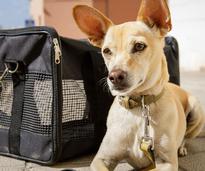
Dogs need a safe place when left alone. Often, having the full run of the house makes them feel restless and unsettled. If your dog likes his crate, by all means, keep him in the crate while you are away. However, if your dog hasn't been crate trained, don't start training him the day the
kids leave for school. That's too late and can actually add to his stress. Also, ask a friend or hire a pet sitter to come by to let your
adult dog out to toilet if you are going to be away longer than 8 hours.
If your dog will be inside all day and is not housebroken or tends to chew inappropriate items, consider confining him to a small room, such as laundry or mud room, using a baby gate.
Be aware that a child coming
home from school may be greeted by an over-excited dog. After being left alone all day, the dog has
pent-up energy. When he sees the kids, his excitement might cause him to become too exuberant.
- Train the
kids - to avoid going right to the dog's
area as soon as they get home. Kids should ignore the pet for several minutes
to allow him to settle down. With young children, it is always safest to have a
parent present to reduce the chance of a problem.
- Train
your dog - to understand what is acceptable and what
is not. Have your dog Sit quietly to be greeted when anyone comes home. You will be rewarded with a more relaxed dog that is happy to see you and be reunited with his family.

A: Whether
your dog is recovering from an injury, illness or surgery, follow the directions given to you by your veterinarian! It is important to
look after his needs and ensure that he has time and space to recuperate.

We feel sorry for our dogs,
but remember that consistent rules and guidance are what our dogs need from us for a safe and
speedy recovery.
Your dog will probably not have the same energy level as usual. He
may want to sleep more. This is a normal reaction to illness or surgery. Think how you feel when you are ill or hurting! Help him heal by minimizing
distractions such as children playing, visitors, and other pets. This could mean keeping him in a separate room, pen
or crate. You might have to take him outside on a leash to do his business, or in some cases, carrying him out if walking is difficult for him.
Spend
time with your dog on a daily basis, stroking and gently grooming him. During that time, you can look for any changes in his skin or coat, unusual discharges or swelling from the
injury. Check with your veterinarian to see if gentle massage is OK. This can
increase circulation to any wounds and help in the healing process.
Keep track of his
weight and let your veterinarian know immediately if your dog experiences any
vomiting or diarrhea. Follow the guidelines
provided by your veterinarian when giving any medication to your dog.
Bandages,
splints, casts or other dressings may be required to help stabilize a healing
fracture or surgical procedure and protect the wound from infection. Dressings
can also provide protection from your dog's natural tendency to lick a wound. If
your dog continually licks at or attempts to remove the dressing, distract him
with a toy or treat, or consider a taste deterrent such as Grannick's® Bitter
Apple.
Once
you receive the go-ahead from your veterinarian, start your dog on his usual routine. Walking
is a great way for you and your dog to reconnect. Go at a slow pace at first, building up his endurance. With your help and patience, he'll be feeling better in no time.

A. We humans
use hugs to communicate our affection. Dogs also use gestures - like nuzzling, nudging and rubbing up against either - to show affection. Using human gestures on our
canine companions, however, can make them uncomfortable.
Here are some suggestions on how to let your dog know how much you love him WITHOUT making him flinch!
NOTE: Parents, please share this with your children.
- Respect your
dog's space. Since dogs don't hug like we do, they often feel cornered or trapped when hugged. Instead of hugging, try petting him instead.

- To a dog, petting is similar to nuzzling. It's relaxing and calming to him. The most enjoyable type of petting we can give a dog is to stroke him under his chin and on his chest. Dogs that are hypersensitive to touch because of age or illness may find even the softest touch startling, so keep your movements slow and even.
- Don't pick
up your small dog. While most of us cannot physically pick up a Bull Mastiff, we don't
hesitate to swoop down and lift tiny dogs like Bichons or Chihuahuas. We forget
that no matter how small, a dog is still a dog. Being held is simply not natural to a dog and puts him
in a position where he may feel trapped, or injured if he should fall.
- Grabbing your dog's collar to deal with issues like jumping
up or bolting out the door can be viewed as very threatening. You may have noticed that the more you pull back on
your dog's leash or collar, the more he pulls forward. This is
a natural, built-in reaction that can cause damage
to the dog's neck and back.
- Help your dog get used to being handled
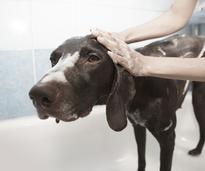
physically for nail clipping, grooming, washing, and veterinary checkups by gently touching his body, head, and feet every day. Make these sessions pleasant by giving him treats, which are both a reward for his good behavior and a distraction while he is being groomed or examined.
By building a foundation of trust with your dog, he will understand that your touch is not only enjoyable but will keep him safe from harm. 
Less
than two percent of cats and only 15-20 percent of dogs are returned to their
owners, according to the National Council on Pet Population Study and Policy. In
honor of National Pet ID Week (April 15-21), let's all give our pets the best
chance of coming home in the event they are lost!
New
technologies mean you now have more options than ever for protecting your pets
if they are separated from you. For example, microchipping is a popular process
in which a microchip about the size of a piece of rice is implanted under your
pet's skin.
When the microchip is scanned at a veterinarian's office or animal
shelter, it will pull up your pet's information in a national database. If your
pet is already microchipped, find your microchip registration card--or contact
the vet or shelter that did the implant to learn where it is registered--and
make sure your contact information is current.
However,
advanced forms of ID do NOT mean you should abandon traditional ID tags on your
pets' collars! This is still the quickest, simplest way for the average person
on the street to help reunite you with your pet.
In honor of National Pet Day, celebrated on April 11, 2012, take the Pet Owner's Pledge:
I recognize that having a companion animal to love, enjoy
and respect is a privilege.
A pet is a living creature, not a "throwaway"
item.
My family and I are aware of our daily responsibility in
caring for a pet and the changes this will make in our lives.
My pet depends upon me for safe shelter, fresh water,
wholesome food, grooming, proper veterinary care and training. I will provide
these to the best of my ability.
When selecting my pet, I will consider the life
expectancy, physical characteristics and behavioral differences among animals.
I will begin to properly socialize and train my pet when
it is one to two months old.
I will control my pet's ability to reproduce in an effort
to prevent the cruel over-production of unwanted animals that will be
abandoned.
I will obey all laws pertaining to my pet in order to
prevent it from annoying or injuring my neighbors.
My pet will be properly identified in a suitable manner at
all times. If my pet becomes lost, I will make every effort to promptly find
it.
If for any reason I can no longer keep my pet, I will not
abandon it. I will do my best to find my pet a suitable home, take it to a
reputable animal shelter, or, if no other choice exists, have the animal
euthanized by a veterinarian.
Signed _____________________________________
|
|
Recent Comments